
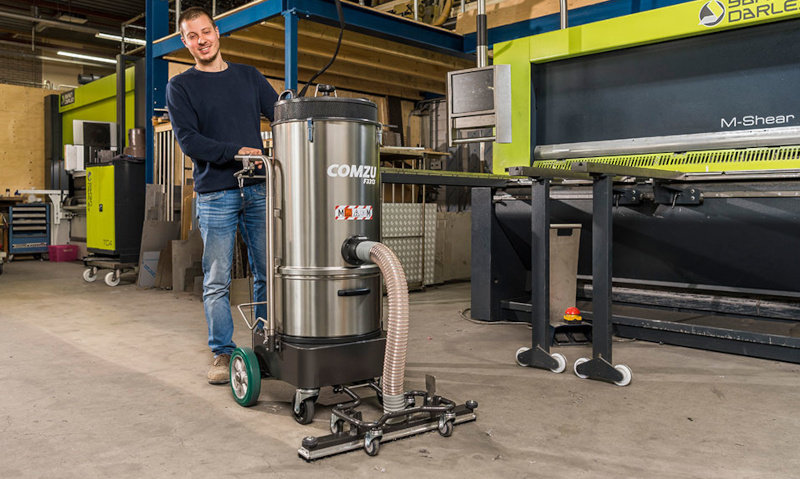
A forklift track coated in fine dust does not stay a housekeeping issue for long. It turns into slip risk, air quality complaints, product contamination, and extra wear on equipment. That is why choosing the right industrial vacuum cleaner for warehouses is less about janitorial preference and more about operational control.
Warehouse and material recovery facility environments create a specific cleaning challenge. Dust, stretch wrap scraps, wood splinters, metal shavings, pallet debris, powders, and liquid spills do not behave the same way, and a machine that works well in a light commercial setting often fails quickly on an active floor. For operations leaders, maintenance teams, and procurement managers, the better question is not simply which vacuum is most powerful. It is which machine matches the material, shift pattern, floor area, and risk profile of the site.
What an industrial vacuum cleaner for warehouses needs to handle
A warehouse cleaning program has to support throughput, safety, and equipment longevity at the same time. In practice, that means the vacuum has to perform well across large square footage, around racks and docks, and in areas where debris type changes throughout the day.
Fine dust is usually the first concern because it spreads fast and settles everywhere – on floors, inventory, conveyors, controls, and charging areas. But many facilities also deal with heavier material such as broken pallet fragments, plastic banding, cardboard dust, or spilled product. Some operations need dry pickup only, while others need to recover liquids, sludge, or mixed waste from maintenance zones and washdown areas.
This is where specifications start to matter. Airflow, lift, filtration grade, tank capacity, hose diameter, and duty cycle all affect real-world performance. High suction alone will not solve a recurring cleanup issue if the filter clogs early, the collection bin is too small, or the machine is not built for continuous use.
Why warehouse buyers outgrow standard vacuums
Many facilities start with a lower-cost vacuum and replace it after repeated breakdowns, weak suction, or filter problems. That usually happens because warehouse cleaning loads are harder than they appear on paper.
A standard commercial vacuum may be acceptable for office-adjacent spaces or very light dry dust. It is usually not the right tool for long shift cleaning, abrasive debris, or environments where operators need to pick up both fine particulates and larger waste. Motors overheat, hoses split, filters load up quickly, and the machine spends more time being emptied than cleaning.
The cost of that mismatch is easy to underestimate. Cleaning takes longer, operators work around poor performance, and dust remains in circulation. Over time, that can affect worker comfort, housekeeping scores, machine reliability, and even product quality in sensitive storage or manufacturing-adjacent areas.
Key selection factors for an industrial vacuum cleaner for warehouses
The right machine depends on what is on the floor and how often it needs to be removed. A spare parts warehouse has different cleaning demands than a recycling transfer building, food packaging site, airport service area, or manufacturing distribution center.
Match the vacuum to the debris stream
If the facility mainly deals with fine dust, filtration should lead the conversation. High-efficiency filtration helps keep captured dust from being pushed back into the air, which matters in enclosed areas and high-traffic aisles. If the debris is bulky or sharp, the intake path and container design become more important. Stringy plastic, pallet nails, and coarse sweepings can bridge, clog, or damage underbuilt systems.
For wet or mixed material, a dry-only unit creates headaches. Tanks, seals, and recovery systems must be designed for liquid pickup. In some cases, separating wet and dry applications across different machines is the more reliable choice, especially when uptime matters.
Consider duty cycle and shift pattern
A vacuum used for a 20-minute end-of-day cleanup is not the same as one used across multiple shifts. Continuous-duty capability matters in larger facilities where cleaning happens during active operations. Motors, cooling, filter cleaning systems, and overall construction should be evaluated with actual run time in mind.
This is also where battery-powered options can make sense. In the right application, they remove cord management issues, reduce trip hazards, and allow operators to move through aisles, docks, and trailer areas with less friction. The trade-off is runtime planning. If a machine will be used across long shifts, battery capacity and charging routines have to be part of the purchase decision, not an afterthought. You also need to consider the better battery choice of LifePO4 over Lithium-ion for battery chemistry safety and 1000’s of repeated recharges restoring 80% or more capacity.
Size for the facility, not just the budget
An undersized machine often looks economical until labor hours are added up. Small tanks require frequent dumping, narrow cleaning paths slow coverage, and limited hose reach can make rack faces, corners, and dock edges harder to maintain.
At the same time, oversizing has its own drawbacks. A very large unit may be harder to maneuver in tight storage layouts or mezzanine areas. The best fit usually comes from balancing capacity with access. If operators cannot move the machine easily where debris collects, cleaning quality drops.
Look closely at filtration and dust control
For warehouses with airborne particulates, filtration is not a minor detail. It affects worker exposure, housekeeping consistency, and whether fine dust is truly being removed or simply redistributed.
Facilities handling powders, packaging dust, or manufacturing byproducts should review filter class, filter surface area, and cleaning method. Manual shaking may be acceptable in low-volume use, but frequent clogging becomes a labor issue fast. More advanced filter cleaning systems can hold performance longer, especially when vacuuming fine or dense dust loads.
Operational benefits beyond cleaner floors
A warehouse or industrial vacuum cleaner should be evaluated as a productivity and risk-reduction asset, not just a cleaning device. Cleaner floors support safer pedestrian traffic, steadier forklift or tow tractor operation, and better visibility of spills or obstructions. Dust control can also reduce buildup on sensors, controls, and moving equipment.
There is a labor benefit as well. When the right machine is in place, routine cleanup becomes faster and more predictable. That matters in facilities already under staffing pressure, where maintenance and housekeeping teams are expected to do more without expanding headcount.
In organizations with sustainability goals, equipment choice may also support broader operational objectives. Battery-powered cleaning equipment can help reduce on-site emissions and noise compared with some traditional alternatives, especially in indoor environments where air quality and operator comfort matter. For companies prioritizing safer, lower-emission facility operations, that alignment is not cosmetic. It affects procurement standards and long-term fleet planning.
Common mistakes during specification and purchasing
One of the most common mistakes is buying based on peak suction alone. Marketing numbers can look impressive, but warehouse performance depends on the full system – airflow, filtration stability, recovery capacity, maneuverability, and durability under actual site conditions.
Another mistake is treating all warehouse debris as the same. Fine paper dust, plastic trim, metal chips, and damp product residue each place different demands on the machine. A vacuum that is excellent for one waste stream may be inefficient or unreliable with another.
Facilities also run into problems when serviceability is ignored. Filters, hoses, squeegees, seals, and wear components should be easy to access and replace. If parts are difficult to source or routine maintenance is complicated, downtime increases and the machine is more likely to be neglected.
How to evaluate fit before you buy
The most practical way to assess an industrial vacuum cleaner for warehouses is to start with the application, not the vendor’s product line-up. Review the debris type, average cleanup frequency, square footage, aisle widths, dock conditions, and whether cleaning happens during live operations.
Then look at operator use. Who will run the machine, how often, and with what level of training? A powerful unit that is cumbersome to empty or difficult to maneuver may underperform simply because teams avoid using it. Ease of operation has a direct impact on compliance and cleaning consistency.
It also helps to think in terms of total cost of ownership. Purchase price matters, but so do labor time, filter replacement frequency, maintenance requirements, battery life, and expected service interval. In many warehouse environments, the lowest upfront price becomes the highest operating cost within a short period.
For operations that also prioritize safer, lower-emission material handling, working with a supplier that understands industrial workflows can make the evaluation process more useful. Companies such as Xerowaste Solutions tend to frame equipment decisions around real site conditions, operator safety, and measurable productivity rather than generic product claims.
Where the right machine makes the biggest difference
The value of a warehouse vacuum is often most visible in problem zones. Dock plates collect grit and pallet debris that can spread quickly across the building. Packaging stations generate recurring dust and plastic waste. Battery charging rooms, maintenance corners, and recycling areas create localized cleanup demands that standard equipment struggles to manage consistently.
In these areas, the right machine does more than clean faster. It helps maintain a safer floor condition, limits airborne dust, reduces repeat passes, and gives crews a tool built for industrial use rather than improvised housekeeping. That shift is usually where buyers start seeing the return.
If your warehouse is fighting the same dust, debris, or spill problems every week, the issue may not be your cleaning schedule. It may be that the machine on the floor was never designed for the job.