
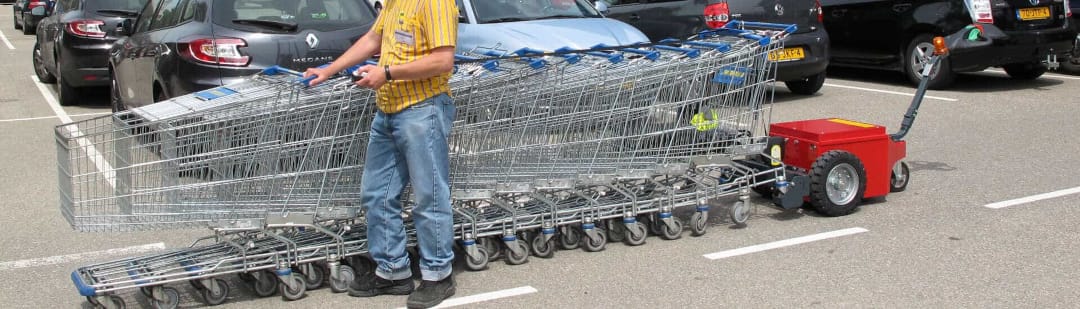
A parking lot tells you a lot about retail operations. If associates are still pushing long trains of carts by hand in traffic, in rain, or up sloped approaches, the risk is already built into the workflow. A shopping cart pusher machine changes that equation by turning a repetitive, injury-prone task into a controlled material handling process.
For store managers, facility teams, and procurement leaders, the question is not simply whether powered cart retrieval is useful. It is whether the machine fits the real operating conditions at your site – cart volume, lot layout, slopes, weather exposure, shift patterns, and the number of carts moved per hour. The right unit can reduce physical strain, improve cart collection speed, and make front-of-store labor more predictable. The wrong one can create bottlenecks, maintenance issues, increase costs, and under perform on grades.
Why a shopping cart pusher machine matters operationally
Manual cart collection looks simple until you calculate the hidden cost. Associates walk long distances, fight rolling resistance, manage uneven pavement, and work around moving vehicles. That combination raises the likelihood of soft tissue strain, fatigue, near misses, and inconsistent collection times.
A shopping cart pusher machine addresses those issues in practical ways. It provides powered assistance for moving multiple carts at once, improves control during acceleration and stopping, and reduces the force operators need to apply throughout the shift. That matters in high-volume retail environments, but it also matters in airports where carts need to be gathered repeatedly across large footprints and over multiple floor levels.
There is also a labor efficiency angle that buyers should not ignore. If one employee can retrieve more carts in less time and with less fatigue, labor can be redeployed to customer-facing or higher-value tasks. In a tight labor market, that is not a minor benefit. It directly affects service levels at peak periods.
What separates a capable cart pusher from a marginal one
Not every powered cart mover is built for demanding daily use. Some are adequate for flat, light-duty environments. Others are designed for heavier train lengths, frequent starts and stops, and operation on ramps or rougher exterior surfaces. The difference shows up quickly in battery life, traction, braking, and operator confidence.
A strong shopping cart pusher machine should first be evaluated on push capacity under real conditions, not ideal ones. A quoted maximum on flat, dry pavement is only part of the picture. If your site has sloped cart corrals, loading-area transitions, curb cuts, or worn asphalt, actual performance may be lower. This is where many purchasing decisions go wrong. Capacity numbers sound impressive until the machine is asked to perform in weather, on grade, or across a long shift.
Traction is equally important. On smooth concrete indoors, many machines perform well enough. Outside, tire design and drive system quality matter much more. Wet pavement, painted markings, leaves, snow residue, and incline changes can all affect control. A machine that struggles for grip creates hesitation for operators and can reduce the number of carts moved safely per run.
Braking and speed management also deserve close attention. Fast is not automatically efficient. In crowded parking lots, predictable low-speed control is more valuable than top-end travel speed. Operators need stable handling when maneuvering around vehicles and pedestrians, especially when pushing a long cart train that can shift or sway.
Matching the machine to your site conditions
The best buying process starts with the route, not the brochure. Measure the actual distances from cart corrals to the store entrance. Note the steepest grade, the narrowest turns, and the roughest surface transitions. Measure the time it will take to collect carts every hour times the number of hours your site is open. Look at peak cart accumulation by time of day and season.
If your operation is in a region with snow, freeze-thaw pavement wear, or frequent rain, those conditions should shape the spec. So should your staffing model. A machine used by multiple associates across shifts needs straightforward controls, simple charging routines, and durable construction that tolerates less-than-perfect handling.
Grades, ramps, and uneven pavement
Grades are one of the most overlooked buying factors. A machine that feels strong on level ground may lose effectiveness on a ramp to the store, at a parking deck transition, or in a lot with poor drainage and surface variation. If your site includes measurable inclines, ask for grade capability, to match the volume of carts you need to move per hour, in practical terms and not just theoretical specifications.
This is especially relevant for operations that already handle carts on more challenging terrain. Companies such as Xerowaste Solutions work in environments where powered movement on significant grades is a routine requirement, and that perspective matters when evaluating whether a unit is truly engineered for demanding conditions rather than light-duty demonstration use.
Battery runtime and charging discipline
Battery-powered equipment is only productive when it is available. That makes runtime a purchasing issue, not just a maintenance issue. If a shopping cart pusher machine is used heavily during weekend peaks or holiday traffic, the battery system must support that demand without creating downtime between collection cycles.
It depends on how your store operates. A smaller format location may do well with standard daily charging and moderate use. A high-volume site may need longer runtime, faster charging, or a backup charging plan to avoid operational gaps. Battery health, charger placement, and staff charging discipline all affect real-world performance.
Ergonomics and operator adoption
Even a technically capable machine can underdeliver if operators do not trust it or find it awkward to use. Handle design, visibility, control response, and ease of connecting to cart lines all influence adoption. The goal is to make safe operation easier than manual work, not to introduce a machine that feels cumbersome in tight spaces.
Training should be short and repeatable. If new hires need extensive explanation just to collect carts safely, the equipment may be too complex for the application.
Safety benefits are only real when the workflow changes
Many buyers talk about safety in general terms, but the real value comes from changing the force requirement and exposure profile of the task. A shopping cart pusher machine reduces the need for workers to brace, lean, and overexert while managing cart trains manually. That can help lower strain risk in shoulders, backs, and upper limbs.
Still, the machine itself is not the whole safety solution. Traffic patterns, collection routes, visibility, lighting, and cart corral placement all matter. If associates still have to make awkward turns in active vehicle lanes or retrieve overloaded cart groups from poorly placed corrals, some risk remains. Powered equipment improves the process, but layout and policy should support it.
For that reason, the best equipment discussions are consultative. They focus on the route, the load, and the operator environment rather than just machine price. A lower-cost unit that does not hold up in your conditions can become the more expensive option once repairs, underuse, and injuries are considered.
How to evaluate return on investment
ROI is often clearer than buyers expect. Start with labor hours spent on cart retrieval, then factor in variability at peak traffic times. Add the cost of delays at the entrance, employee fatigue, and the injury exposure associated with repetitive pushing in outdoor conditions.
The value case usually comes from a combination of outcomes rather than one dramatic number. You may see fewer manual handling issues, more consistent cart availability, faster lot clearing, and better use of labor across the front end. For multi-site operators, standardizing the cart retrieval process can also improve training and simplify fleet planning.
It is fair to say that not every location needs the same level of machine. A compact site with low cart volume may justify a lighter-duty solution. A big-box format, a high-traffic grocery store, or a site with sloped parking areas will usually benefit from a more capable machine with stronger traction, higher push capacity, and battery performance that supports longer shifts.
Questions worth asking before you buy
A good vendor should be able to answer specific operational questions without falling back on generic specs. Ask how many carts the machine can move on your actual grades. Ask what happens to runtime in cold weather. Ask what routine maintenance looks like, how parts support is handled, and what operator training is required.
Also ask about serviceability. Components that are easy to access and replace can reduce downtime and extend useful life. Ask who will service your machine locally or provide preventative maintenance and safety checks. If the machine will be mission-critical during peak retail periods, service support should be part of the purchasing decision from the start.
The strongest equipment decisions usually come from a site-based review of load, grade, frequency, and operator use. That is how you avoid buying a machine that looks right on paper but struggles where it counts.
A shopping cart pusher machine should do more than move carts. It should make a repetitive outdoor task safer, more controlled, and easier to manage day after day. It should also reduce operating costs and help to increase your store revenue per hour. If it cannot do that in your real conditions, keep looking. The right machine earns its place by performing when the lot is full, the weather turns, and the work still has to get done.