
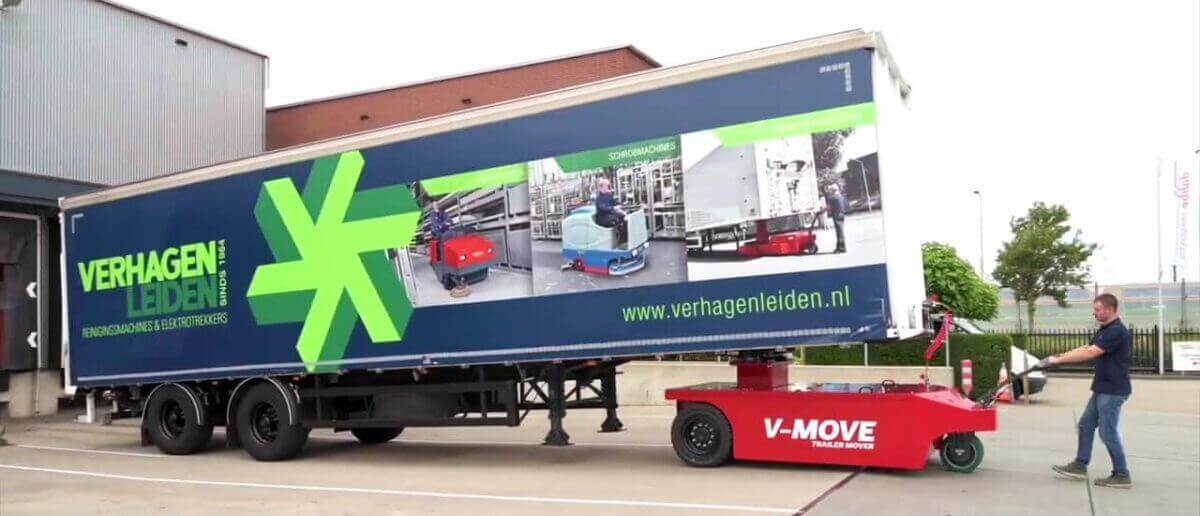
A trailer that needs to move 20 feet can create a full shift of problems. When a yard truck is oversized for the space, when a forklift is being used for a job it was never designed to do, or when staff are pushing placement tasks into already busy schedules, trailer movement becomes a safety issue as much as a logistics issue. That is exactly where a semi trailer positioning tug fits – giving facilities a controlled way to place trailers accurately without relying on improvised methods.
Where a semi trailer positioning tug makes sense
Most facilities do not need a full yard tractor for every trailer move. They need a compact, purpose-built machine that can reposition semi trailers in confined spaces, at loading docks, between staging areas, or inside production and service environments where diesel equipment is a poor fit.
That distinction matters. A semi trailer positioning tug is not trying to replace every road or yard application. It is built for on-property short-distance movement, high precision, and repeatable control. For operations managers, that usually translates into fewer delays around the dock, less reliance on larger equipment, and a safer process for the team handling trailer placement.
The need shows up across industries. Manufacturing plants use positioning tugs to shift trailers between doors and staging lanes. Distribution and retail facilities use them to handle frequent trailer changes in tight service yards. Waste and recycling transfer station and MRF operators may need trailer movement in constrained, high-traffic environments where visibility and control are more important than top speed. In each case, the common factor is simple – the trailer must move safely, accurately, and without wasting labor.
Why facilities move away from forklifts and manual workarounds
A lot of trailer repositioning problems start with the wrong tool already on site. Forklift operators are often asked to move trailers because they are available, not because they are appropriate for the task. That can create stability concerns, visibility limitations, and avoidable wear on equipment that should be doing other work.
Manual methods are no better. If trailer alignment depends on spotters, repeated backing attempts, makeshift couplers, or physically demanding adjustments by staff, the process is already costing more than it appears on paper. Labor time gets absorbed in small increments, and the injury exposure rises every time a heavy load is moved without the right machine.
A semi trailer positioning tug addresses that gap with controlled traction, deliberate movement, and operator visibility suited to close-quarter maneuvers. The gain is not just speed. It is consistency. No license is required to operate the semi trailer tug, so that reduces the dependency upon a higher paid commercial licensed driver. Once a facility can position the same trailer in the same way every time, dock activity becomes easier to schedule and easier to manage.
What to look for in a semi trailer positioning tug
Not every tug is a fit for semi trailer duty, and not every trailer application demands the same specification. Buyers should start with operating conditions, such as slope and surface type, and not just trailer weight.
Tractive force is the obvious first question, but gradeability often matters just as much. A facility with ramps, uneven pavement, or outdoor approaches needs to know how the machine performs under load on an incline, not only on a flat slab. Tire type, wheelbase, and traction design also affect whether the tug can maintain control when the surface is wet, snow covered, or imperfect.
Coupling setup is another practical consideration. Fast, secure trailer engagement reduces wasted motion and keeps operators from improvising. If you have frequent changes in slope, left to right, along a path you need to ensure the 5th wheel is fully articulating (left, right, front, and back) and not just tilt-able front to back. You also need to know if the machine will handle the trailer pin size you have. Attachment compatibility should be reviewed early instead of becoming a field modification later.
Battery performance matters too, especially in multi-shift operations. Electric equipment brings clear advantages for indoor air quality, noise reduction, and emissions goals, but battery runtime, charging strategy, and duty cycle need to match the site conditions. In hot or cold climates, you need to ensure the battery chosen can operate in the needed temperature range. A semi trailer tug that is designed to perform well for overall time needed and for the temperature conditions will be the right choice.
Operator ergonomics should not be treated as secondary. Good visibility, responsive controls, stable handling, and straightforward training all affect how quickly a tug becomes part of daily workflow. If the machine is awkward to use, teams will find reasons to avoid it. If it makes the job easier, is safe to use, and works in all conditions, adoption follows quickly.
Safety is usually the real business case
Many purchases start with a productivity problem, but the strongest long-term case is often safety. Trailer positioning combines heavy loads, limited space, and frequent pedestrian interaction when on site. That is not an area where organizations should rely on routine workarounds.
A purpose-built tug will have power steering to reduce manual strain by eliminating pushing, pulling, and repeated adjustment around a loaded trailer. It also reduces the temptation to use larger vehicles in spaces where turning radius and sightlines are poor. Better control at low speed helps operators place trailers precisely at the dock, which lowers the chance of impact damage to doors, walls, equipment, and the trailer itself. A well-engineered tug will also have an option for remote control, trailer and tug lighting, and rear cameras to make the job safer and easier.
For facilities facing workers’ compensation exposure, near-miss concerns, or pressure to standardize safe movement practices, that matters. The value of a semi trailer positioning tug is not limited to how fast it moves a trailer. It is also in how predictably it removes risk from a task that is easy to underestimate.
Electric trailer positioning is not just about emissions
Zero-emission equipment is often discussed in terms of sustainability targets, and that is a valid driver. But in trailer positioning applications, electric power has day-to-day operational benefits that tend to matter just as much.
Indoor and partially enclosed environments benefit from an electric tug by eliminating exhaust. Noise reduction improves communication around docks and service areas with a quiet electric semi-trailer mover tug. Fully electric drivetrains, including dual motors, also support precise low-speed control, which is exactly what trailer placement requires. The tug should have safety features built in to automatically slow in corners, slow down when you turn the wheel sharply, and safely brake on slopes. The machine does not need to sprint across a yard. It needs to start smoothly, hold traction, and stop where the operator intends.
That said, electric is not automatically the right answer unless the equipment is matched to the work. Battery capacity and type, charging windows, ambient conditions, and route grade all influence performance. Facilities should evaluate the actual movement cycle rather than assume any electric tug can handle any trailer application. This is where application knowledge matters more than broad equipment claims.
Common mistakes during selection
The biggest mistake is sizing from maximum trailer weight alone. Actual operating conditions often tell a different story. Surface quality, slope, wheel resistance, frequency of starts and stops, and trailer configuration all change what the tug must do.
Another common issue is ignoring traffic flow. A trailer positioning tug may be technically capable of the move, but if the path to and from the dock is congested or poorly marked, the equipment cannot deliver its full value. In many facilities, small layout changes and clearer staging procedures improve results as much as the machine itself.
Procurement teams also sometimes treat trailer movement as a standalone equipment purchase rather than part of a broader workflow. The better approach is to look at labor allocation, dock scheduling, damage history, operator training, maintenance support, and charging requirements together. That creates a more accurate return-on-investment picture.
The operational payoff of getting it right
When trailer positioning is handled with the right tug, the change is usually visible within days. Operators spend less time waiting for larger vehicles. Dock teams deal with fewer alignment issues. Supervisors gain a process that is easier to standardize across shifts. Maintenance teams see less abuse of forklifts that were previously covering trailer moves. Safety leaders get a cleaner, more defensible procedure for a high-risk task.
For organizations with decarbonization goals, the added benefit is that trailer movement can be addressed without introducing another combustion unit into the fleet. For industrial sites, recycling operations, and facilities dealing with tight layouts or challenging grades, that can be a practical way to improve both operational performance and environmental performance at the same time.
Xerowaste Solutions works with facilities where material movement is rarely simple on paper and even less simple on the ground. Some of their staff has been professionally trained and licensed to drive semi trucks and have the knowledge of what is needed. The right equipment is not the one with the biggest spec sheet. It is the one that matches your trailer weight, your grade, your surfaces, your shift pattern, has the smarter engineering put into its design, is high quality to last with less maintenance and be more dependable, and meets your safety expectations.
If trailer placement is still being handled with a workaround, that is usually the signal. A dedicated semi trailer positioning tug does more than move a load – it gives the operation a safer, more controlled way to keep the day moving.