
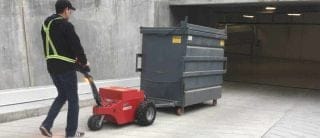
A full dumpster rarely feels heavy until your team has to move it across broken pavement, around parked vehicles, and up a loading ramp before the day is half over. That is where an electric dumpster mover stops being a nice-to-have and starts looking like a practical control measure for safety, labor efficiency, and uptime.
For many facilities, the real issue is not whether a dumpster can be moved. It is how often that movement depends on manual force, a second employee, or a workaround that increases risk. In waste rooms, back-of-house corridors, hospital docks, retail service lanes, apartment properties, and industrial yards, those workarounds add up fast. Strain injuries, property damage, slow collection cycles, and avoidable delays tend to follow.
What an electric dumpster mover actually solves
At its core, an electric dumpster mover is designed to let one operator safely push or pull heavy bins and dumpsters with controlled power. That sounds simple, but the operational impact is broader than reducing physical effort.
Manual dumpster handling usually breaks down in predictable places. The first is startup force. A loaded container that has been sitting on uneven ground or has one wheel binding often takes a hard initial shove to get moving. The second is grade. Even a modest incline can turn a routine move into a high-risk task. The third is control in tight areas, where hand force alone does not provide consistent braking, steering, or positioning.
Electric movers address those pain points with powered traction, operator controls, and coupling options that make movement more repeatable. For operations leaders, that matters because repeatable handling is easier to train, easier to standardize, and easier to improve.
Why facilities are replacing manual dumpster moves
The business case is usually less about the equipment itself and more about the hidden cost of the current process. If two employees are needed to move a bin safely, labor cost is already higher than it looks on paper. If maintenance teams wait for the strongest person on shift to handle containers, workflow is already constrained. If employees avoid moving full bins until the route becomes urgent, service levels are already slipping.
Safety is often the trigger for change. Repetitive pushing and pulling is one of those tasks that appears ordinary right up until someone tweaks a shoulder, strains a back, or loses control on a slope. The incident may not involve dramatic equipment failure. It is usually a common task performed under less-than-ideal conditions.
The environmental side also matters, especially for organizations with electrification or emissions goals. Replacing fuel-powered support equipment or reducing dependence on larger vehicles for short internal moves can support broader decarbonization plans. That benefit is real, but for most buyers it only holds weight when the machine also improves daily operations.
The specs that matter most in an electric dumpster mover
Not every electric mover is built for the same environment, and this is where buyers often make the wrong comparison. Rated towing or pushing capacity is important, but capacity alone does not tell you how the machine will behave in your facility.
Gradeability is not a side detail
If your site includes ramps, dock approaches, parking structures, service alleys, or outdoor pads with uneven elevation, gradeability deserves close attention. A mover that performs well on flat indoor floors may not be the right fit for a site with steep transitions or wet concrete.
Ask what load it can handle on the grades you actually have, not just the maximum load on ideal conditions. Wheel condition, surface type, and container caster quality all influence real-world performance. A strong machine on paper can still disappoint if your application includes poor rolling resistance.
Traction and control affect safety more than top speed
In dumpster handling, speed is rarely the goal. Controlled starts, predictable stopping, and confident maneuvering matter more. Operators need enough traction to move the load without wheel slip, especially outdoors in snow or on wet or greasy surfaces. They also need controls that allow precise positioning when backing bins into compact storage zones or aligning them at a dock.
A machine that is easy to feather at low speed is often more valuable than one with a higher travel speed spec. The best fit depends on whether your team is covering long distances, navigating narrow and winding service corridors, or working around pedestrian traffic.
Coupling method shapes workflow
How the machine connects to the dumpster is a practical issue, not an accessory decision. Some operations need a quick hitching method for repeated moves across many bins. Others need a more secure attachment for heavier loads or steeper grades.
The right setup depends on dumpster style, caster arrangement, and route conditions. If your site uses multiple bin types, compatibility becomes part of the purchasing decision. It is worth evaluating whether one mover can serve several applications with different attachments rather than adding separate equipment later.
Battery performance has to match shift reality
Run time should be assessed against your actual duty cycle. A site moving bins occasionally across a flat service area has different needs than a property team doing repeated outdoor hauls throughout the day. Charging opportunity, battery chemistry, ambient temperature, and backup unit availability all shape what “enough run time” really means.
Buyers should also think beyond battery hours and consider serviceability. If the machine is mission-critical, access to parts, preventive maintenance, and support matters just as much as battery spec sheets.
Where electric dumpster movers deliver the most value
The strongest returns often show up in environments where heavy bin movement is frequent, awkward, or inconsistent. Multi-building properties are a good example. When teams regularly move dumpsters across long outdoor routes, the saved time per trip may look modest, but the reduction in physical strain and route variability can be significant over a week or month.
Hospitals and institutional campuses also benefit because waste handling happens in tighter, more controlled environments. A powered mover helps maintain cleaner workflows, reduces manual effort in service corridors, and can improve consistency for teams working around patients, staff, or public traffic.
Retail, airports, manufacturing sites, and distribution facilities tend to value these machines for a different reason: congestion. In busy back-of-house operations, any equipment that helps one operator move a heavy load with better control can reduce delays and lower the chance of contact with doors, walls, carts, or parked assets.
When a basic unit is enough – and when it is not
There is no advantage in overbuying. Some facilities have light-duty needs, flat surfaces, short travel distances, and well-maintained dumpsters. In those cases, a simpler electric mover may be sufficient and easier to justify.
But applications with steep grades, mixed indoor-outdoor travel, damaged pavement, heavier commercial containers, or poor caster conditions usually need more than a basic machine. This is especially true in waste and recycling operations, where bin condition and route variability are rarely ideal. If your environment is demanding, buying too light often creates a second procurement problem within a year.
This is where a consultative approach pays off. A supplier with real experience in waste and material handling will ask about slope, surface, load weight, route length, turning constraints, and attachment needs before recommending a model. Xerowaste Solutions operates in exactly that kind of application-focused space, where the wrong spec choice can affect both safety and productivity.
Questions procurement and operations should ask together
An electric dumpster mover should not be selected by procurement alone or by operations alone. The best decisions usually happen when both groups look at the same handling task from different angles.
Operations should define the real task conditions. How heavy are the dumpsters when they are hardest to move, not when they are empty? What grades are involved? How often are moves delayed because the load is difficult to start or control? Procurement should then test the long-term fit. What support is available? Are parts and attachments accessible? Can the same unit support future use cases beyond dumpsters?
That last point matters more than many buyers expect. A powered tug selected for dumpster movement may also support tote handling, trailer positioning, cart trains, snowplowing, or internal logistics tasks. When the equipment can cover multiple workflows, payback often improves.
Adoption works best when the process changes too
Buying the machine is the easy part. Getting full value from it usually requires a small process reset. Operators need clear training on attachment, travel routes, slope handling, and parking. Supervisors need to define when powered movement is required instead of optional. Maintenance teams need a simple plan for charging, inspection, and wear items.
Without that structure, a good machine can end up underused while staff fall back into old habits. With it, the equipment becomes part of a safer standard operating method rather than a backup tool.
The most useful way to think about an electric dumpster mover is not as a replacement for human effort alone. It is a control point in the handling process – one that can reduce strain, improve pace, and make heavy container movement far more predictable. If your team moves dumpsters in places where grades, congestion, or repeated manual force are part of the job, the right machine can change the quality of that work in a very practical way.
If you like this article, see our other recent article: Zero Emission Material Handling Equipment